Sunday, 22 September 2013

Sunday's stuffing

We had a couple of slightly aging peppers in the fridge that I was keen to use up but as we were expecting a big delivery from the online supermarket on Monday so I didn't want to make anything for lunch that required the acquisition of any more ingredients. Unfortunately I discovered that we had no onions left. This was too restrictive but I would just pop to the shop quickly, I had to go out to buy tarpaulin anyway. Popping to the shop quickly didn't happen – it was absolute mayhem – but I was successful in acquiring an onion so lunch could proceed.

I decided to do stuffed peppers. Rather than bother with any sort of recipe I just made it up as I went along. One of the things that I sometimes don't like about stuffed peppers is when the peppers are crunchy. Crunchy peppers are for salads and dips, otherwise they should be soft and sweet. So I halved (lengthways) a yellow and an orange pepper, covered in boiling water and blasted in the microwave for a couple of minutes.

While they cooled I worked on the filling; this was going to be couscous based. I started by chopping and sweating my hard acquired onion, still unsure of what the rest of the filling was going to be like. I was tempted to go for my usual “camping” couscous but I'm trying to reduce the rate at which we get through tinned tomatoes. So for savouriness and protein I added a load of vegetarian mince to the pan – about as twice as much by volume as the onion. I cooked that for about 10 minutes and then tipped in the couscous, about the same amount by volume as the onion plus the mince, plus some veg stock powder and black pepper.

I have never quite recovered from a couscous incident when I was a student (my mum had assured me that you can't go wrong) in which I added too much water, so tried to correct the balance by adding more couscous, then it was too dry so in went more water. And so on until I had got through a whole packet of couscous and all I had was a gelatinous mess, too much for my jug and thus all over the work surface too. Since then I have been very careful with couscous, either being very precise with my measuring or adding water just a very little at a time. Today I went for the second of these techniques and added just a tablespoon or so of boiling water to the pan at a time. It was successful and I had lovely fluffy couscous.

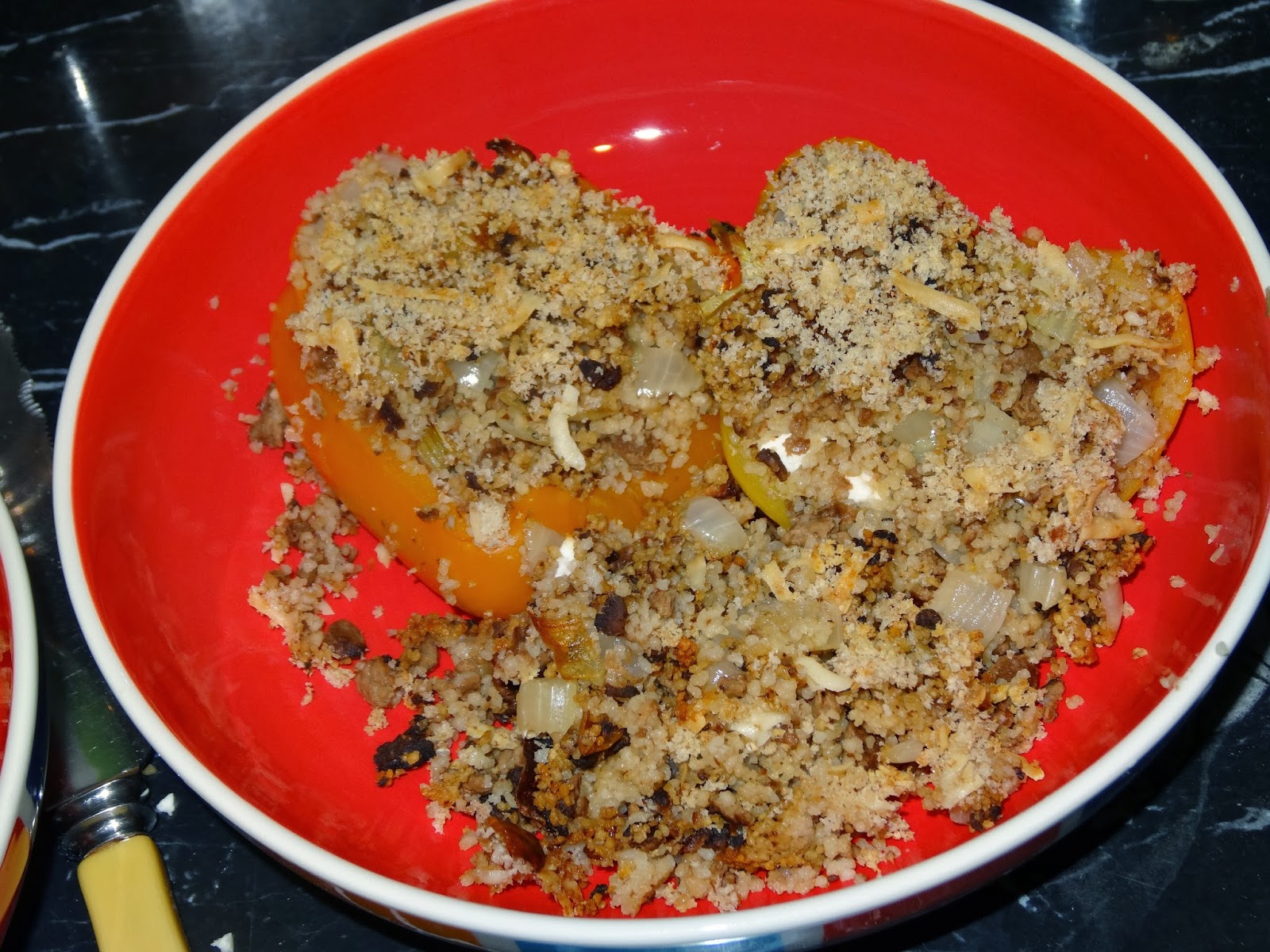
Now to fill the peppers. I laid out the pepper halves in a deep pan and half filled each of them with the couscous mixture (it became apparent that I had far more filling than was strictly needed). Then I put on a sprinkling of feta (a bit of spontaneous cheese addition was sure to improve the whole thing) and then topped off with more filling. I could have saved the rest of the filling for another day but wasn't really in the mood for that so poured the rest of it around the peppers. Now I thought about, this would serve to stabilise the peppers in the pan.

Somehow it didn't seem finished. I keep coming across breadcrumbs in the freezer and thought that adding some as a topping would add a bit of interest in the texture. (I am mainly saving these breadcrumbs from a bargain loaf of bread in the Spring to make Christmas puddings, but the consensus is that this should be done in November). I augmented the breadcrumbs with a bit more spontaneous cheese (just a little grate of parmesan this time) and more black pepper, sprinkled over the stuffed peppers / loose couscous and put it all in the oven at 180ºC. Having never made this before I had no idea how long it would take, but everything was pre-cooked so burning was the main risk. I took it out when the top had started to crisp up nicely.

Really the stuffed peppers should have been served with a lovely crisp green salad, but we had nothing suitable from which to assemble this so I just served them with extra of the filling. They were really nice. The microwaving of the peppers had really done the trick to make them nice and soft, the filling tasted just good and the spontaneous cheese additions did indeed improve the whole thing. It would be nice with a few toasted pine nuts too.
Saturday, 21 September 2013

Saturday's sweet things

Recently I've mostly gone off sweet things, and therefore haven't had them in stock. But this evening I really fancied a nice biscuit. I now faced a choice:
1. Get changed out of my pyjamas and make my way to the corner shop to take a chance that they had something nice in stock.
or
2. Make something myself.
I went for option 2.

Still not being in total sweet-toothed mode I was feeling quite picky about what sort of biscuit I was going to make. It would have to feature ginger or lemon. Having done a lot of ginger baking recently I opted for lemon. It being reasonably late I didn't want anything too complex so had in mind some sort of lemony shortbread. I found a recipe for orange shortbread and felt that it would be reasonably safe to substitute the orange for lemon.

Not wanting to feel left out Matt, my husband, decided that he wanted to take part in some kitchen based activity too. He announced that he was going to make a crumble (probably his second favourite non-chocolate pudding). We usually have plenty of fruit in the freezer, the current selection being cherries, gooseberries and raspberries (or maybe loganberries). After persuading Matt that none of these were likely to make a good combination (there's a conspicuous absence of apple which goes with everything in a crumble, a bit like yeast extract in savoury dishes) he settled on just defrosting the gooseberries.

Meanwhile he made the crumble topping. This is one of the most reliable recipes that my mum has ever given to me and requires just a little manipulation of ratios:
  • 3 parts flour (you can substitute some with oats, but Matt didn't today)
  • 2 parts sugar (a reasonably grainy sort, Matt used caster, granulated would probably have been fine or even including a bit of demerara. You can actually reduce the amount of sugar)
  • 1 part fat (I think butter is best)
For a usual sort of size crumble 1 part = 50g is fairly good. Matt mixed the dry ingredients together and then rubbed in the butter.

It was a good job that my shortbread recipe didn't require the rubbing in of butter as this is to be avoided whilst in a dressing gown. Instead I whisked together the butter and sugar and lemon rind, stirred in the flour and only had to use my fingers to pull it all together into a ball. I tried a new technique for rolling out. On a popular television baking contest I have noticed that the contestants often use their rolling pin on top of a piece of greaseproof paper. Not wanting to waste greaseproof paper I used my rolling pin on top of a thin plastic chopping board (at least that's what I've always used them for before today, I think mum gave them to me). This worked really well to get an even roll and no unwanted stickage.


Matt was now concentrating on applying the crumble topping to the gooseberries and I was getting tired. When I get tired get very bad at making decisions so I slightly distracted Matt and asked him what shape lemon shortbread he would like: hearts. I can do hearts and not having totally lost my decision making faculties decided to go for smallish hearts – this would make more which would hopefully mean the whole lot would last longer.


Both of our creations were ready to go in the oven at the same time. The lemon shortbread were ready after 10 minutes or so. The crumble would take a little longer. Unfortunately my biscuit craving wouldn't be met for a few minutes yet as I had to wait for the shortbread to cool. But that few minutes passed quickly enough and the first test was with the mis-shapen bit that was left over after I made all the hearts. A little bit of warm lemon shortbread was just what I was after and then I was ready for bed.

But Matt was keen that I try his crumble, so I agreed to a spoonful. But spoons come in different sizes and the kind of spoon that Matt had in mind was clearly larger than the kind of spoon I had in mind. Still, it was tasty, not too sweet and the top was nice and crunchy (yet slightly gooey – in a good way – where it met the fruit), and I slowly made my way through my portion.

I was definitely ready for bed now and Matt agreed to package up the food. The crumble would make a good Sunday pudding. The recipe said that the shortbread would keep for 2 weeks in an airtight container – obviously the recipe does not take into consideration the resilience of the householders when faced with something delicious.

When it came to pudding time on Sunday I was slightly confused. When we went to bed there was definitely enough for a bowlful of crumble each. Now all that was left was some gooseberries. According to Matt the rest of the crumble had just disappeared somewhere. On further questioning it transpired that it had disappeared into his mouth. But I had psyched myself up for pudding so undeterred decided to turn the remaining gooseberries into a fool. I am not sure what the technical definition of a fool is but I basically added some crème fraiche and tinned custard (about the same amount of each) to the gooseberries, so that overall there was approximately a 1:1 ratio of fruit to creamy stuff. It was absolutely delicious. Possibly (but don't tell Matt) even more delicious than the original crumble.

As for the shortbread, I give them half a week max.

Wednesday, 18 September 2013

Wednesday's men and ladies

I had foolishly promised one of my work mates some form of ginger baking for today. This was a foolish promise because I hadn't really planned how I would fit baking into my evening – there were a lot of chores that needed doing. On the plus side baking is preferable to chores. My services were also to be called upon for a rehearsal of an imminent best-men speech (yes, there are two of them).

I fancied doing some sort of biscuits and had a browse of my recipe books. There were loads of recipes for different types of ginger biscuits so I opted for what seemed to be the easiest, involving the fewest ingredients, from one of my most trusted recipe books: gingerbread men. Thus far I'd managed one chore – putting away the groceries that had just arrived from a large internet order. I decided that in order to achieve my chore goals I'd need to do some multi-tasking so put a load of washing on before starting work on the baking.

The recipe said to melt 2 tablespoons of black treacle with 50g of butter and 15ml of milk. Thinking about it now I'm not sure that the milk is really necessary but the book has “dairy” in the title so I think they're keen to get as many farmyard products in as possible. I have found that it's very difficult to accurately measure any type of treacle or syrup product in any units apart from grams (or another actual weight I suppose). This was further complicated because the recipe seemed to indicate that 2 tablespoons of black treacle is equivalent 60ml. As far as I'm concerned one tablespoon is 15ml (no matter what the substance), so I was confused. I wasn't about to start working out the density of black treacle so I just went with 2 big dollops of black treacle.

While that was melting I mixed together 100g plain flour, 50g sugar (soft brown) and 1 (generous) teaspoon of ground ginger.

The next instruction was to mix the treacle mixture into the dry ingredients until it formed a soft ball. Once I'd thoroughly mixed the two sets of ingredients it resembled nothing like a soft ball. It was more of a sludgy cake mixture. In retrospect perhaps I should have just beaten in an egg and turned it into a cake but in my mind I was committed to gingerbread men. So I added a bit more flour in the hope of turning the sludge into a soft ball. After several additions of flour (just a little at a time) I worried that the ginger would be losing its potency so I added another shake of this. With a few more little additions of flour my soft ball finally formed.

The final part of the pre-bake was surprisingly uneventful. I rolled out to about half a centimetre and then cut out both men and lady shapes (with a clever double-sided cutter that I had acquired from my mum). They baked for about 10 minutes at 180°C and came out looking remarkably like gingerbread men and ladies.

Gingerbread men and ladies aren't the same without decoration. The recipe had said to apply currants for eyes, nose, buttons etc before baking but we didn't have any currants and sultanas were too big. So I decided to risk some post-baking icing. Icing is not my strong point. Cautious to avoid my usual mistake of making it too runny I tipped a load of icing sugar into a bowl and very slowly added water, just half a teaspoon at a time. It's on occasions like these that I would like to own some food colouring. But I don't, so we would have to make do with all white features. I was not about to start using a piping – this would require my full concentration and by now I was in full swing with the best men speech. Instead I applied the icing with a cocktail stick (or tooth pick if you prefer) and finished off with a few silver balls.

I don't think they were the greatest gingerbread men and ladies ever made – slightly on the tough side – but my colleagues were very polite and said that they enjoyed them and no-one lost any teeth.

Even still, next time I'm going to try a different recipe. And maybe I'll invest in some food colouring.

(In case you were wondering the best men speech went down very well).

Tuesday, 3 September 2013

Sunday's gingerbread

Recently, I have had a bit of a problem:
  • Matt remains adamant that he wants to lose some weight
  • I am keen to support Matt's health kick
  • I love making cake
  • Matt can't resist eating it if there is cake in the house
* Therefore by making cake and leaving it in the house I am implicit in impeding Matt's slenderising efforts.

So whenever there's an opportunity to bake a cake to share with others I'm only too happy to do this. The current occasion was a visit from Matt's sister and brother-in-law and a visit for all of us down to some friends in Cornwall.

I decided that I wanted to make something gingery. I had loads of recipes for gingery things but, overwhelmed by the choice, I chose to make something that I didn't have the recipe for: my granny's gingerbread. My granny was a great baker (I have particularly fond memories of her chocolate melting moments) and I remember her gingerbread being rich and moist and delicious.

A telephone call to, and an email from my mum (complete with attachment) later I was ready to go. Mum had even converted the recipe to metric for me which, given that the scales can do imperial, was unnecessary but very kind (imperial makes my brain go a little bit funny).

Like all the best recipes this one is very simple and requires no complex techniques.

1. Melt together 100g of butter (the instructions from mum actually said margarine but butter usually tastes better although I suppose that margarine might be more authentic if it's a WW2 era recipe), 100g of sugar (I used soft brown sugar) and 250g of black treacle (mmm, I love black treacle). I intended to do this in the microwave (again, very non-authentic but granny did embrace mod-cons) but first had to eliminate the smell of garlic from said appliance. In the early hours of the morning Matt had decided that he would cook a garlic bread in the microwave (that's a whole other story) and it now wreaked. So I found an old lemon and squeezed it into a wide bowl and put it in the microwave on high for a few minutes – this is a very effective microwave de-odourising method. The melting of the ingredients took just a few 20 second blasts on high with a stir in between each one.

2. Sift / stir together 275g plain flour, ½ teaspoon of salt, 1 teaspoon of bicarbonate of soda, 1 teaspoon of ground ginger and 1 teaspoon of ground cinnamon (I was pretty generous with the spices).

3. Whisk up an egg with 200ml of milk (whisking with a fork is adequate).

4. Stir the egg / milk into the dry ingredients – it looked a bit like raw bread dough when I'd done this bit.

5. Stir the butter / sugar / treacle mixture into the rest of it. I used a wooden spoon and just kept mixing until it all looked even.

6. Add some lumpy bits if you fancy – I used a large tablespoon of chopped stem ginger and a handful of sultanas. Some chopped nuts might also be nice. I had to resist the temptation of adding loads because I figured this would absorb a lot of the moisture and dry out the gingerbread.

7. Pour into a lined 20cm square tin (that's what the instructions said but I used a long loaf tin instead) and bake at 150-160ºC (fan) for one and a half hours. At least that was the instructions, I think it might have got away with a little less time.

Matt just about managed to squeeze the loaf into our largest plastic food box for the trip westwards. It was extracted again after we had let our delicious barbecue dinner go down. All seven of us had a slice, some of us two. I was informed that it went very nicely with crème fraiche and there was one voice who lamented the lack of clotted cream but I enjoyed mine very much just as it was. There was a unanimously positive verdict including (what I rate as a key indicator of success) a request for the recipe. And Matt was saved from himself as our hosts were only too happy to finish off the leftovers over the next few days.

(I'm waiting for my sister-in-law to send me the pic that she took of the finished product! In the meantime I'm sure you can use your imagination.)

It wasn't as sticky as I remember Granny's gingerbread being but tasted just right. On a follow-up phone call to my mum to report of the outcome, she told me that it gets stickier (and thus probably better) with age – up to a point. Apparently it will keep well for up to a week. So I'm going to do another one midweek for next weekend.

Saturday, 31 August 2013

Thursday's roast

A small thing made this dinner blogworthy. I will come to that small thing later.

We'd enjoyed fish and chips with my mother-in-law on Wednesday night and I was due out for a hen night meal on Friday so Thursday needed to be a healthy day. The most healthy thing would probably have been a salad, but I didn't fancy that. What I fancied was something that would use up my bargain aubergine that was looking like it wouldn't last much longer. And I didn't fancy another moussaka. So what I decided on was roasted vegetables with lentils. Augmented with some cheese, thus making a highly healthy dinner slightly less healthy, but with the added bonus of cheesy tastiness and calcium.

I selected the vegetables while heating a little olive oil in a big dish in the oven. As well as the aubergine, there was a golden courgette from our garden (it is supposed to be golden) and I decided to use a red pepper too. I could have added some carrot and potato but didn't want to break the theme (which I suppose was loosely Mediterranean). In the time it took to chop all the vegetables the oven had reached temperature (hottish) and so the roasting process started.

Many of my friends frown at me when I extol the tastiness of lentils, but they really can be delicious. Tonight I would be doing some simple braised lentils. I started off by gently “sweating” (sorry, horrible word) an onion, a couple of sticks of celery and a couple of carrots (all chopped fairly small). I didn't measure the lentils, probably about 100g (but I'm not good at estimating weight), enough to come up about half way in a normal size sieve. The lentils go in the sieve to be rinsed thoroughly. I once had a bit of grit in my lentils so at least by rinsing them the risk is reduced to clean grit. The lentils then go in the pan with the onion, celery and carrot and I added enough water (from a boiled kettle) to just cover everything. As is my preference I added some yeast extract (from a squeezy pot that Matt bought – here is not the right forum to go into the pros and cons of yeast extract in squeezy pots versus the traditional jar) and a spoonful of vegetable stock powder. Then all I did was to leave it to simmer on the hob and hope that it would be ready at the same time as the roasted vegetables.

The vegetables looked to be coming on nicely, but needed some seasoning. (Watch out, the small thing is coming up soon.) I added salt and pepper and sent Matt out to the garden to choose some herbs. He chose some oregano (at least I think it is oregano, it might be marjoram, but oregano and marjoram might actually be the same thing). Matt duly washed the herb (we have some unreliable neighbourhood cats) and threw it in on top of the vegetables in the oven.

This was all going on in the background while I topped and tailed some green beans that my mum had sent us home with from her garden. I was disturbed from my top and tailing reverie by a cry of “Quick get some tongs!”. It transpired that Matt's herb washing had failed to dislodge (or even identify the presence of) a caterpillar. Being the animal lover that he is Matt was frantic to save said creature. I extracted the dish from the oven, Matt found the tongs and extracted the caterpillar from the dish. Being the animal lover that he is that was not sufficient for Matt so while I returned to my beans he took the caterpillar to the park.

I wanted tomato to feature somewhere in this dinner – it would probably be ok added to either the lentils or the oven vegetables. If I only had tinned tomatoes it would have been a no brainer to add these to the lentil pan, but I had some lovely cherry tomatoes and decided that I'd put a few of these (minus caterpillars) in the oven. So it would be a kind of oven roasted ratatouille.

Everything was sort of looking ready so I took a chance and put the green beans in to cook. I also added a splash of balsamic vinegar to the lentils, it adds just a little sharpness otherwise they can be very rich. All that was left for me to do was to chop the feta (almost any strong / salty cheese would probably be fine but we had two blocks of feta for some reason) and beckon Matt to serve it all up (I am useless at serving food).

As usual Matt made a beautiful job of serving the food, and as usual this combination tasted delicious. There was no trace of caterpillar, which was a good job for a vegetarian dinner.

Saturday, 24 August 2013

Wednesday's moussaka

I had a bit of time to make tea as Matt was off on a rescue mission to his grandad's. I had it in mind to make a moussaka because I'd bought a couple of cheap aubergines at my favourite cut price supermarket the day before. Usually the only thing I do with aubergine is curry so the extra time available would be a good opportunity to do something a bit different.

Lots of recipe books tell you that you're supposed to do some sort of fancy thing with aubergines that involves salting them but I have never done this before and didn't intend to start now. So I just sliced them and put them in the griddle pan to pre-cook.

In the meantime I got on with the main sauce. I was working totally recipe-free (I have made moussaka before so did vaguely know what I was doing) and my main challenge was going to be qauntities. In terms of proportions I knew what I was aiming for so started off with an onion (well actually one and a half onions because I had half of one left over from something or other last week) and a couple of sticks of celery. Next were some some mushrooms that were starting to look a bit wrinkly.

That all started to cook down and I started to contemplate my protein content. It was unconventional but I had most of a tin of baked beans left over and decided to put those in. The tomato sauce would probably be sufficient liquid for the whole thing. I planned to augment the beans with some vegetarian mince but when it came to it I found that we only had a tiny amount in the freezer, so augmented further with some vegetarian chicken style pieces. I seasoned with some veg stock, black pepper and a good dollop of yeast extract.

So far everything was going smoothly (if a little unconventionally) so now it was onto the white sauce. I suppose the white sauce for a moussaka has some sort of special name but I'm not sure what that is. I started off with a good dollop of butter substitute and about the same of flour in smallish saucepan and cooked these for a little while. I believe this is called making a roux. Next I added milk and then I left this on a low heat to thicken, whisking occasionally. At least that was the plan.

The sauce resolutely refused to thicken. I whisked a bit more. It still resolutely refused to thicken. I left it for a bit longer. It still resolutely refused to thicken. I turned the heat up. It still resolutely refused to thicken. I lost patience and chucked in a spoonful or so of cornflour. I knew as soon as I'd done this that it was the wrong move. Cornflour can be a very useful thing but it can also be a very disastrous thing. On this occasion it was disastrous. I should have learnt from previous mistakes and made a paste with the cornflour before adding but as I said I had lost patience by this point. The cornflour immediately formed lots of lumps in the sauce, which despite vigorous whisking resolutely refused to disperse.

At this point I should probably have cut my losses and started again, but I couldn't bring myself to do this. So I put the sauce through a sieve to catch the lumps and changed strategies. I would thicken the sauce by adding thicker things – cheese and crème fraiche – and try the microwave – rather than the hob – for heating purposes. This seemed to be somewhat successful.

I took a break from the sauce and returned to the aubergine and beany stuff; having chosen an ovenproof dish of what I had deemed to be an appropriate capacity I layered these up, finishing with a layer of aubergine. Clearly I had underestimated the required capacity because the dish was filled right up to the top, leaving barely any space for the sauce. So I got a fish slice and squished the contents of the dish down as much as I could.

Back to the sauce which had now slightly cooled and I whisked in an egg. This makes it rise a little bit which is kind of cool. I carefully spooned as much of the sauce as possible over the moussaka, which wasn't very much of the sauce. Rather than waste the rest of the sauce I decided to add another egg and try to make some sort of soufflé things. Never having made soufflé before this was exceedingly risky. I was now quite tired so rather than faff around looking for the most appropriate container to make soufflé in I divvied it up into some fairy cake cases. I had no idea about temperature so put everything in the oven at 180°C and would keep a close eye on it all.

After about half an hour everything was ready, this happily coincided with Matt's (partially successful) return from his rescue mission. We enjoyed our moussaka with a side of broccoli. I think it's unconventionality made it even tastier. I didn't partake of the soufflé things (I don't like the taste of egg) but Matt assures me that they were nice (if a little bland). It was certainly entertaining to watch him munch them from their paper cases, and maybe I'll even try an actual soufflé some time.


Tuesday, 20 August 2013

Sunday's blackcurrant bake

My colleague Jan had very kindly given me a bowlful of blackcurrants from her garden. Blackcurrant is one of my favourite flavours of all time (developed I think from an early fondness for cassis sorbet on holidays to France), but I have never cooked with them before. I could have gone for a granita (the closest to a sorbet that I'm ever likely to attempt), but decided that a cake might be in order. There was an early evening beach barbecue planned and I wanted to make something that I could take to share.

There was nothing suitable in any of my recipe books, so I got out my shoe box of recipes extracted from magazines. The only specific blackcurrant recipe used jam rather than whole blackcurrants. There were quite a few for general summer or other berry puddings, but I had no other sort of berry. In the absence of what I was looking for I was going to have to improvise, but improvising on a blueberry recipe would surely be a fairly safe bet – I chose a tray bake recipe.

I did my usual of scanning the ingredients before I started (I was amazed that we actually had half a bag of flaked almonds in the cupboard – I've no idea what the other half went in), but not looking at the method. If I had looked at the method I might have thought twice before embarking on this recipe – it ended up using loads of bowls and pans and given me a clue as to the number of separate processes to be completed.

First you are directed to deal with the blueberries, by turning them into a kind of sauce – so I set to with my blackcurrants. I had no appreciation of how long it would take to remove the little stalky bits from 150g of blackcurrants. I started off by trying to chop them off with a sharp knife (our sharpest) but this was unbearable so I ended up yanking with my finger-nails (clean, short and unvarnished for those of you concerned about infection control). I would recommend that you wear an apron to make these as blackcurrants turn out to be very messy. I would especially recommend to wear an apron if you are baking in your favourite pyjamas.

Once you have (finally) prepared the blackcurrants, you add them to a small pan with 100ml water, 2 teaspoons of cornflour and 50g caster sugar and then heat / stir until it starts to thicken. I'm not sure mine thickened as much as it was supposed to, maybe blackcurrants have less thickening agent (pectin I think) than blueberries. I will put a bit more cornflour in next time, or a bit less water. I think that blueberries are sweeter than blackcurrants so maybe you would want to slightly increase the sugar but I really like the not-too-sweetness of blackcurrants.

While that was on the hob I started with the main cakey bit. This was not a normal cake method, more like a pastry method and I generally have to psych myself up to make pastry – I wasn't feeling psyched but it was too late. You combine flour, sugar, ground almonds and baking powder and then rub in butter. Fortunately the food processor came to my rescue and did the rubbing in bit for me. Then you stir in a beaten egg. It wasn't looking hopeful, very crumby, but eventually came together in a sort of doughy mixture. It still looked kind of dry and I was very tempted to add a splash of milk, or even another egg, but resisted and pressed this mixture into the base of a 20cm square tin (I had gone to the effort of greasing this).

By which time the blackcurrant mixture was ready (or if it wasn't I was going to wait any longer) and I poured this over the “cake”. Then I discovered the destiny of the flaked almonds. They go in another pan with some milk and honey and brown sugar which you are supposed to heat until it started to thicken slightly. But it was kind of difficult to tell whether it had thickened in the presence of the flaked almonds so I just heated for a few minutes (the oven had been at it's pre-heated temperature for quite a while now) and then poured this mixture over the top of the blackcurrant.

It baked for about 35minutes and then you have to cool it in the tin. After which time the extraction from the tin proved quite challenging. I ended up cutting it up into 4 squares and then scooping out with a fish slice which didn't create too much carnage, there were just a few crumbs left in the tin for me to test. The test indicated that it tasted nice, although I probably wouldn't have done any harm in adding a bit more moisture to the cake layer. 


I packed up a boxful to take to the beach. Unfortunately by the time it came to get the cake out everyone was full up with barbecue, except Matt who I'm not sure I have ever known to be full up, so I brought most of it back home again (if I had been organised I would have taken some food bags so that people could have taken a goodie bag home, but I wasn't organised). We've been making our way through it over the last few days – it seems to keep very well in an airtight box – but I'm going to take the rest to work tomorrow.